Goldmund decides to pursue sculpture
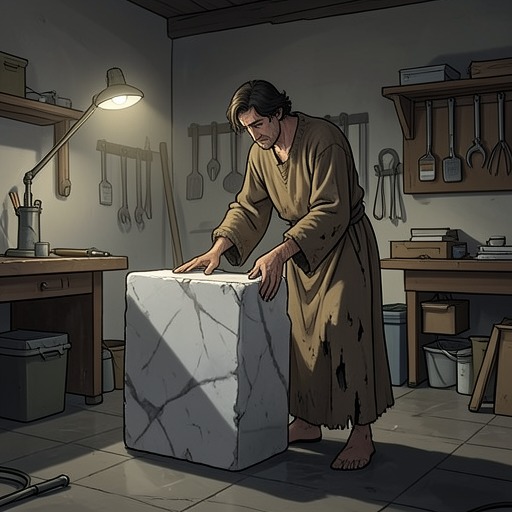
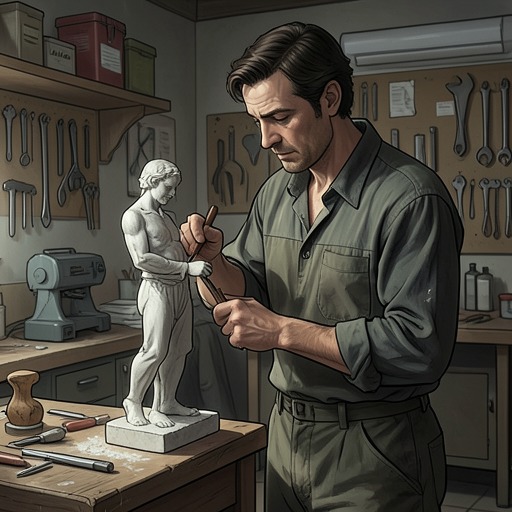
Narcissus and GoldmundGoldmund’s decision to pursue sculpture begins with an encounter with a wooden Madonna and becomes a turning point in his wandering life: for the first time, his road acquires a definite destination. The figure’s unusual union of sorrow, beauty, and spiritual presence seems to confirm thoughts he has carried without knowing what to do with them. He seeks out Master Niklaus, wins permission to learn despite being far older than a customary apprentice, and discovers in carving a practice through which memories, bodily experience, and ideas about suffering can take form.
The Madonna and the Discovery of a Vocation
After confessing in a cloister church, Goldmund is preparing to leave when a shaft of sunlight draws his attention to a wooden Madonna in a side chapel. She leans forward beneath a blue cloak, extending a delicate hand; her living expression combines a grieving mouth with beauty and spiritual intensity. The statue arrests him. He turns away more than once, but each time feels drawn back to look again, as if it embodies something he has seen in dreams and long wished to find.
The priest explains that the image is controversial. Some viewers consider it too modern and worldly to represent the Mother of God, while others respond to it as a work of great force. It was made by Master Niklaus, a carver in the bishop’s city, and had been given to the cloister by a benefactor the previous year. That account connects Goldmund’s private response to the public life of religious images: the same statue that speaks to him as an intimate discovery is also an object of debate and a recent addition to a cloister church.
Goldmund recognizes in the Madonna an expression he had been trying to understand: suffering that is also joy. He had thought about how bodily forms correspond to temperament, and how the face of pain during childbirth can resemble that of ecstasy. In the statue, these perceptions appear joined rather than opposed. The encounter does not merely inspire admiration; it makes his scattered thoughts seem usable and gives them a possible artistic purpose.
From Wandering to the Workshop
Goldmund leaves the church with a goal. The highway that had been a place of freedom and diversion becomes a road leading to the city and to the master. He arrives before evening, asks strangers where Niklaus lives, and persists until he finds the right street. The next morning, after staying overnight at a cloister, he reaches the workshop and tells Niklaus that love and reverence for the Madonna have brought him there. He asks to become the master’s apprentice.
To explain his request, Goldmund describes his observations of the relation between bodily shape and character, as well as his conviction that pain and ecstasy can share an expression. He says that Niklaus’s Madonna gives form to what he had only thought and dreamed, and that seeing it made him understand where he must go. Niklaus listens, but distinguishes the ability to speak about art from the ability to make it: in his workshop, work is carved, and a person’s ideas matter only alongside what his hands can produce. He asks Goldmund to draw so that he can judge his capacity directly.
The terms of entry reflect the distance between Goldmund’s calling and the ordinary structure of the craft. A guild apprentice would generally begin at thirteen or fourteen, serve for years, and have his apprenticeship paid for by his father. Goldmund is a grown, homeless wanderer, not a boy entering the standard route. Niklaus therefore does not take him on under a formal contract. After seeing Goldmund’s drawing, he calls it flawed but beautiful and offers him the chance to learn informally, provided he can support himself in the city. He may use the workshop, break carving knives or spoil blocks, and leave whenever he chooses; if wood carving proves unsuitable, he can try something else. Goldmund accepts the arrangement gratefully, understanding that the master will not assume responsibility for him as he would for a young apprentice.
Learning, Experiment, and Artistic Difference
In the city, Goldmund learns to work with wood, plaster, colors, varnish, and gold leaf, and develops into an able draftsman. Niklaus occasionally lets him model in clay. His first successful work is a small clay figure of Julie, Lydia’s younger sister. Niklaus praises it but will not sponsor its casting in metal, judging it too worldly and unchaste. The episode marks an early difference between Goldmund’s attraction to the living and sensual world and the master’s judgment about what is appropriate to make and authorize.
Goldmund’s next important undertaking is a wooden Saint John, intended to represent Narcissus. Niklaus hopes that, if successful, it can join a crucifixion group on which his assistants have been working. Goldmund approaches this work differently from his diversions in the city. Love affairs, drinking, dancing, gambling, and quarrels can keep him from the workshop or leave him distracted at his bench; when he is ready to work on Saint John, he does so with devotion and humility. In the carving, he feels that Narcissus’s identity is emerging through his hands, rather than being imposed by the artist’s conscious will. The work becomes a means of giving a lasting form to a person Goldmund loves and remembers.
The Madonna also leads Goldmund toward a larger, still unrealized artistic ambition. His image of the mother, once bound to the memory of his own mother, has absorbed the faces of women he has known, including Lise and Lydia. It changes with each new encounter, yet he hopes one day to make visible not a portrait of one particular woman but an original maternal figure, joining ecstasy, pain, and death. Sculpture thus offers him a way to work with memory and experience without reducing them to a single remembered face.
Vocation Against Stability
Niklaus’s workshop gives Goldmund access to training and materials, but it also exposes the friction between artistic vocation and settled professional life. Goldmund can find the master’s commissioned work, the prospect of money, and the claims of property repellent. Niklaus, for his part, is troubled by his pupil’s indifference to money, repeated love affairs, brawling, and unreliable attendance. He nevertheless continues to tolerate him because he sees the exceptional quality developing in the Saint John. Their relationship is therefore sustained by the work even when their habits and expectations do not agree.
After Goldmund completes the statue, the city’s comforts and the workshop’s purpose lose their hold on him. He feels the impermanence of desire and beauty, and his attention turns again to the eternal mother: the work has reached completion, but completion does not make him willing to remain. Niklaus tries to give him a permanent professional future. He persuades the guild to grant Goldmund a master’s diploma and proposes that they become partners, sharing important commissions and earnings rather than keeping Goldmund as a subordinate. The offer is also meant to secure the workshop’s future, since Niklaus believes Goldmund can make work beyond the ability of his paid assistants.
Goldmund does not settle into that future. His departure makes clear that the initial decision to pursue sculpture is a commitment to making art, not a promise to accept a fixed home, career, or professional identity. Later, after returning to Mariabronn, he again puts the craft at the center of his life. He prepares an empty shed as a workshop, arranges for tools and materials, selects timber, and builds a drying roof. For his first work at the cloister, he chooses the unadorned steps and lectern in the refectory, designing carved panels that will belong to the building and its daily life. The plan divides the work into the world and the word of God: the oak-trunk stairs will carry scenes of creation, nature, patriarchs, and prophets, while the upper parapet will bear the four apostles, including figures recalling Abbot Daniel, Father Martin, and Master Niklaus.
Narrative Significance
The decision to pursue sculpture transforms an inward recognition into a course of action. Goldmund does not arrive at the craft through a conventional apprenticeship or a secure professional plan; he follows the Madonna’s example, persuades a cautious master to test him, and learns through work whose outcomes remain uncertain. The contrast between his nonconformity and the guild’s age, payment, and advancement rules makes the material conditions of his vocation visible without making them its measure.
The episode also establishes sculpture as a way of holding together experiences that Goldmund repeatedly encounters as inseparable: beauty and pain, bodily life and spiritual meaning, individual memory and a more universal image. The Madonna awakens the vocation, Saint John turns attachment to Narcissus into a carved likeness, and the later refectory project places sculpture within communal religious space. His artistic purpose persists through changes of location and circumstance, even as his resistance to settled life repeatedly draws him away from the institutions that might make a stable career possible.